Matières
Niveaux
 100%
100%
 100%
100% 100%
100%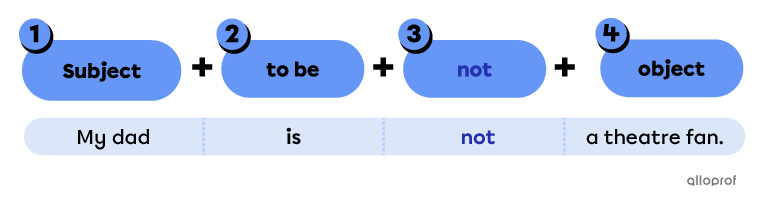 100%
100% 100%
100%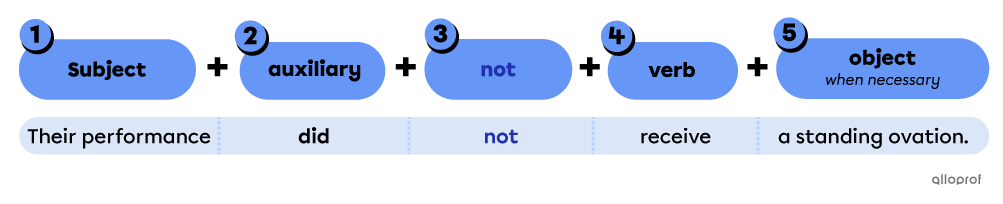 100%
100% 100%
100% 100%
100% 100%
100% 100%
100% 100%
100% 100%
100% 100%
100% 100%
100% 100%
100% 100%
100% 100%
100%
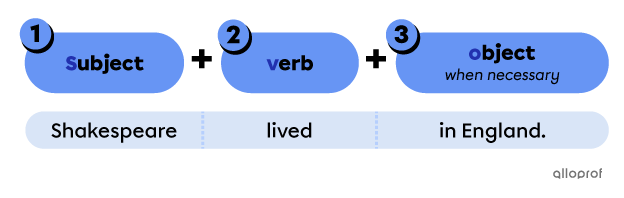
The usual structure of a sentence is:
Subject + Verb + Object (SVO)
To make a sentence, you usually need:
a subject (S): the person, people or thing(s) doing the action
a verb (V): the action (can sometimes be separated into a main verb and an auxiliary verb)
an object (O): information that adds context to the subject’s action (when necessary)

| Subject | Verb | Object* |
| William Shakespeare | is | a famous playwright. |
| He | wrote | Romeo and Juliet. |
| Many famous actors | have interpreted | King Lear. |
| Some characters | were screaming. | |
| The theatre company | is rehearsing | Lady Macbeth. |
| Part of the audience | cried. |
*The object is not always necessary.
Sometimes, adverbs or transition words can be added to the sentence.
Many adverbs can be placed just before the verb in an affirmative sentence.
| S | Adverb | V | O |
| His characters | often | fight. | |
| We | finally | understood | the character's pain. |
The adverbs can also be placed between the auxiliary verb and the main verb.
| S | Auxiliary verb | Adverb | V | O |
| Theatre companies | are | still | producing | Shakespeare's plays. |
| Romeo | will | always | love | Juliet. |
When a transition word is placed at the beginning of a sentence, before the subject, use a comma after it.
| Transition word, | S | V | O |
| As a result, | Shakespeare | became | famous. |
| However, | some people | doubt | his authorship. |
As you can see, even when we add other parts in an affirmative sentence, the order always remains SVO.
To make a negative sentence in the simple present or simple past with to be, you usually need:
a subject: the person, people or thing(s)
the verb to be
the function word not
an object: information that adds context to the sentence
The verb to be is particular, because its negative form does not use an auxiliary verb in the simple present and the simple past unlike other verbs.
| Full Form | |||
| Subject | to be | not | Object |
| Shakespeare | was | not | an only child. |
| You | are | not | an actor. |
| Cordelia | is | not | greedy. |
| Contracted Form | ||
| Subject | to be + not | Object |
| Shakespeare | wasn't | an only child. |
| You | aren't 're not |
an actor. |
| Cordelia | isn't 's not |
greedy. |
“To be or not to be, that is the question” is a line from Hamlet.
Verbs other than to be use an auxiliary verb to form a negative sentence.
In this case, the structure usually is:
a subject: the person, people or thing(s) doing the action
the auxiliary verb: first part of the verb or helping verb.
the function word not
a verb: the action (in its base form)
an object*: information that adds context to the sentence (when necessary)
* The object is not always necessary.
Full Form
| Subject | Auxiliary verb | Not | Verb | Object* |
| Shakespeare's wife | did | not | see | him often. |
| My brother | does | not | understand | his plays. |
| Spectators | should | not | talk. | |
| We | are | not | waiting | for a sequel. |
| Subject | Aux. verb + not | Verb | Object* | |
| Shakespeare's wife | didn't | see | him often. | |
| My brother | doesn't | understand | his plays. | |
| Spectators | shouldn't | talk. | ||
| We | aren't | waiting | for a sequel. | |
* The object is not always necessary.
Affirmative sentence
This theatre company performs Hamlet.
Negative sentence
This theatre company does not perform Hamlet.
Affirmative sentence
I like his comedies.
Negative sentence
I do not like his comedies
Affirmative sentence
This play ended well.
Negative sentence
This play did not end well.
Verbs that have two or more parts in their affirmative form already use an auxiliary verb. Simply add the word not after the auxiliary verb.
Affirmative sentence
Romeo will court Juliet.
Affirmative sentence
The scenario has been approved.
Negative sentence
Romeo will not court Juliet.
Negative sentence
The scenario has not been approved.
Affirmative sentence
The audience was listening quietly.
Negative sentence
The audience was not listening quietly.