Subjects
Grades
 100%
100%
 100%
100% 100%
100%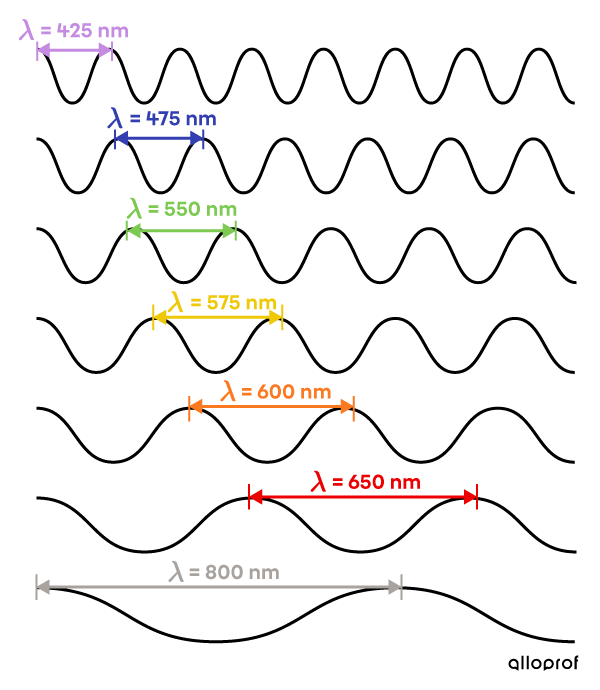 100%
100% 100%
100%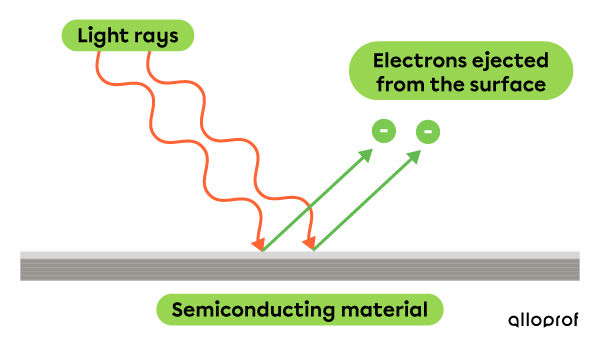 100%
100%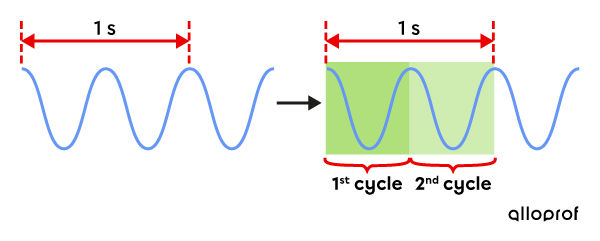 100%
100%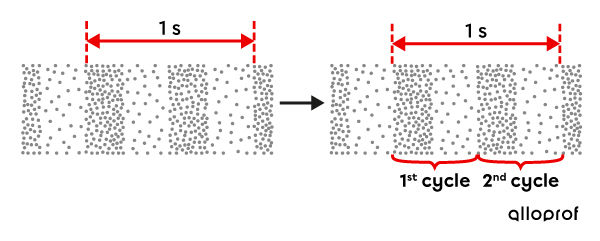 100%
100%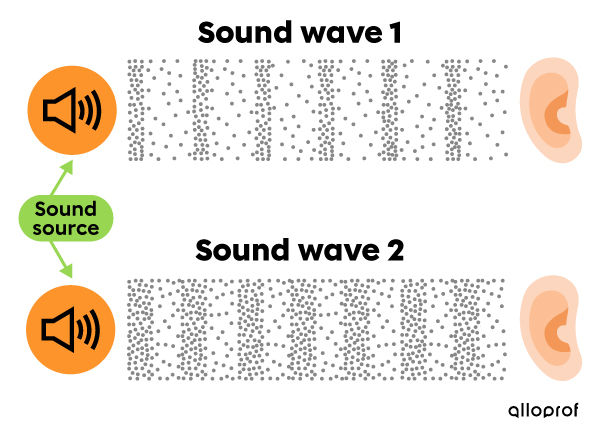 100%
100% 100%
100% 100%
100% 100%
100%
Transverse waves and longitudinal waves can be described by several characteristics. Here are a wave’s main characteristics.
There are also other characteristics (period, energy, etc.). All the characteristics have an influence on wave propagation.
The amplitude of a transverse wave corresponds to the maximum height reached by the wave relative to its position at rest.
The amplitude of a longitudinal wave is evaluated according to the maximum pressure of the particles compressed by the wave. More precisely, the amplitude corresponds to the difference between this maximum pressure and the normal pressure of the medium in which the wave propagates. The amplitude is symbolized by the letter |A.|
So the amplitude |(A)| is evaluated differently depending on whether the wave is transverse or longitudinal.
A transverse wave can be represented by graphing its vertical position |(y)| based on the distance travelled horizontally |(x).| In this context, the amplitude corresponds to the maximum height of the wave (wave crest).
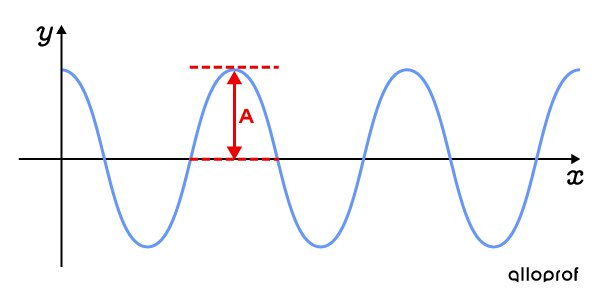
Determining the amplitude of a transverse wave
A longitudinal wave can be illustrated by showing the wave’s effect on the particles of matter. Using air as an example, a longitudinal wave brings certain particles closer together (high pressure zone) and moves other particles away (low pressure zone). It is difficult to represent the amplitude of a longitudinal wave on this type of diagram.
However, a graphical representation of the change in the pressure exerted by the particles in relation to the distance travelled by the wave |(x)| is easier to visualise and can be used to assess the value of the amplitude. It corresponds to the maximum value of the pressure change.
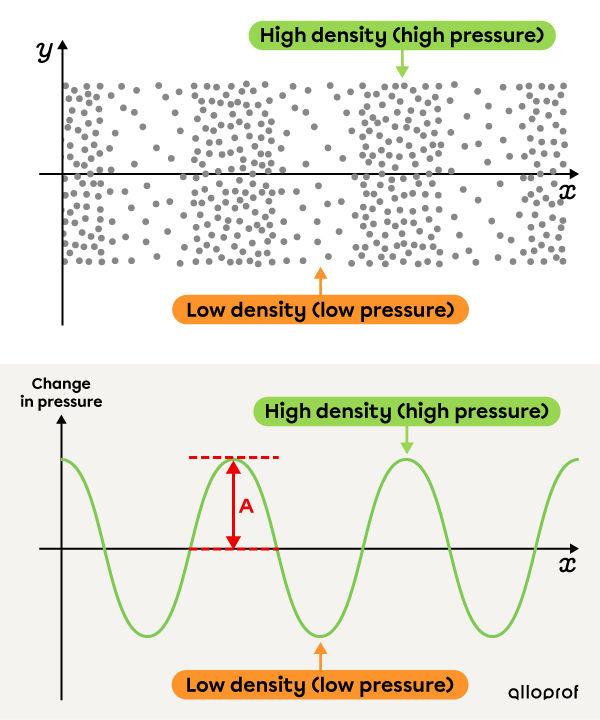
Determining the amplitude of a longitudinal wave
The amplitude of transverse waves is expressed in metres |(\text{m})| or using other units derived from the metre (i.e., kilometre, nanometre, etc.). The appropriate unit is determined based on the greater or lesser amplitude of the wave.
The amplitude indicates the intensity of the wave. The intensity has an influence on the properties of the wave. It determines the volume of a sound wave or the intensity of a light wave.

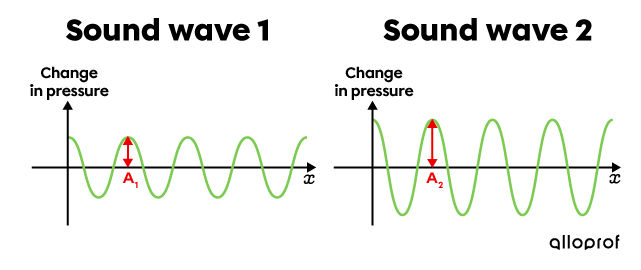
Comparing the amplitude of two sound waves
Sound wave 2 has a larger amplitude than sound wave 1. This implies that the loudness of sound wave 2 is louder than sound wave 1.
The wavelength corresponds to the distance travelled by a wave to complete a cycle. It is denoted using the Greek letter |\lambda| (lambda).
The wavelength |(\lambda)| is evaluated differently depending on whether the wave is transverse or longitudinal.
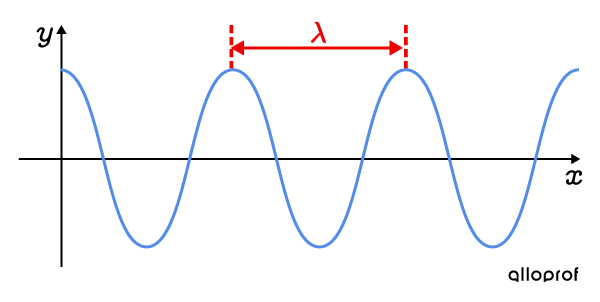
Determining the length of a transverse wave

Determining the length of a longitudinal wave
The wavelength is expressed in metres |(\text{m})| or other units derived from the metre (i.e., |\text{km},| |\text{nm},| etc.) and is determined based on the length of the wave. The length of a visible light wave is often expressed in nanometres |(\text{nm})| while the length of a radio wave is expressed in metres |(\text{m})| or in kilometres |(\text{km}).|
Wavelength can be calculated using the following formula.
|\lambda=\dfrac{d}{N}|
where
|\lambda| represents the wavelength (usually in |\text{m}|)
|d| represents the distance travelled by the wave (usually in |\text{m}|)
|N| represents the number of cycles carried out by the wave
What is the value of the wavelength in the following image?
Distance travelled by a transverse wave
The wavelength has an influence on the properties of a wave. It can have an impact on the colour of light, the way the wave interacts with matter, the type of electromagnetic wave, the amount of energy transported by the wave, etc.
The eye is the organ responsible for vision. It perceives the light waves between approximately |400| and |700\ \text{nm}.| For example, light waves with a wavelength of |425\ \text{nm}| are perceived as violet light. When the wavelength is larger, such as |650\ \text{nm,}| the colour of the wave is actually perceived as red. A wave of |800\ \text{nm}| long appears colourless to the human eye.
Wavelength and colour perception
The sun is a source of several types of radiation, including visible light and UV rays.
Visible light has a wavelength lying approximately between |400| and |700\ \text{nm.}| This type of radiation is not harmful to the skin.
However, an excess of ultraviolet light |(\text{from }10\ \text{to}\ 400\ \text{nm})| is dangerous and harmful to the skin. It is why we must protect ourselves against it.
Waves emitted by the Sun
There are several types of solar panels. Some of them include a semi-conductive surface that captures sunlight.
When the wavelength is too long, their energy is low. Therefore, the energy is not sufficient to eject the electrons from the metallic surface. If the wavelength decreases enough, the light rays will carry more energy, which will force the electrons to move.
Therefore, by capturing the energy transported by short solar wavelengths, radiant energy can be transformed into electrical energy.
Diagram showing how a solar panel works (photoelectric effect)
The frequency of a wave is the number of cycles the wave completes in one second. It is denoted by the letter |f| or by the Greek letter |\nu| (nu).
Frequency |(\nu| or |f)| is evaluated differently depending on whether the wave is transverse or longitudinal. It is measured in seconds to the power of negative one |(\text{s}^{-1})| or in Hertz |(\text{Hz}).|
The following diagrams represent a transverse wave and a longitudinal wave of equal frequency.
Example of determining the frequency of a transverse wave
Example of determining the frequency of a longitudinal wave
In the above two images, the wave carries out 2 cycles in |1\ \text{s}.| So the frequency is equal to |2\ \text{Hz}| or |2\ \text{s}^{-1}.|
Like wavelengths, the frequency has an influence on the properties of the wave. It has an impact on how the wave interacts with matter, the amount of energy it carries, the pitch of the sound, etc.
The frequency of sound waves influences the pitch perceived by the human ear. When their frequency is low, as in the case of sound wave 1, sound waves seem lower to the human ear.
When their frequency is high, as in the case of sound wave 2, the sound waves seem to have a higher pitch.
Comparing the frequency of two sound waves
The human voice enables us to communicate using sounds with a frequency between |40| and |1\ 550\ \text{Hz}.| Dolphins, on the other hand, communicate using sounds, but also using ultrasound with frequencies over |20\ 000\ \text{Hz}.|
Dolphin communication
FM radio uses waves with a frequency generally between |87.5\ \text{MHz}| and |108\ \text{MHz}.|
The dial of a radio is used to change the frequency of the signal picked up by the antenna. It is how we can switch from one station to another.
Radio
X-rays are high frequency waves (between approximately |10^{16}| and |10^{19}\ \text{Hz}).| It causes the waves to interact with the electrons present in the atoms, making it possible to generate X-ray images. The images are used, in particular, in the medical field.
X-ray image of a patient's skull
The speed of a wave corresponds to the distance travelled by the wave in a given time. It is denoted by the letter |v.|
Speed is usually measured in metres per second |(\text{m/s}).|
|v=\lambda f|
where
|v| represents speed |(\text{m/s})|
|\lambda| represents the wavelength |(\text{m})|
|f| represents the frequency |(\text{Hz or s}^{-1})|
The formula demonstrates that frequency and wavelength are two intrinsically linked characteristics. At constant speed, as the wavelength increases, the frequency of the wave decreases. As the wavelength decreases, the frequency of the wave increases.
Like other wave characteristics, speed has an influence on wave propagation.
During a thunderstorm, we see lightning before hearing thunder. In fact, the sound wave propagates at a speed of |343\ \text{m/s},| while the light wave propagates at an average speed of |300\ 000\ \text{km/s}.| So light reaches our eyes faster than sound reaches our ears.
Perception of thunder and lightning during a thunderstorm