ADHD: Tips and Tricks to Make Studying and Homework Time Easier

Article

Attention deficit disorder with or without hyperactivity (ADHD) is a condition that affects a person’s organizational skills and ability to concentrate, and sometimes even their self-esteem. It is characterized by a tendency toward inattention, which may be accompanied by hyperactivity and impulsivity that interfere with the person’s day-to-day functioning. These challenges can make homework time particularly tough. The Alloprof writing team surveyed parents and compiled a list of their most effective strategies. Here are their experiences and their advice on the main challenges they have faced.
Trouble Focusing

Trouble focusing is a major challenge for all the children of our survey respondents. Émile shares an original tip: “Whenever we can, we incorporate movement into homework time. For instance, when we’re working on math or French vocabulary, we’ll toss a ball back and forth every time my child gets an answer right. We also use timers and keep a stress ball nearby to channel excess energy.” Many people with ADHD concentrate better when they are allowed to move. However, Clinique FOCUS (link in French) recommends that you talk to your child and try out different strategies to find what works best for them.

“When I had to memorize things, I would make up songs or use mnemonic devices. And if there was a concept I didn't understand, I would put a star next to it, then at the end of class, I would go see my teacher and ask them to explain it to me,” says Marie-Isabelle.

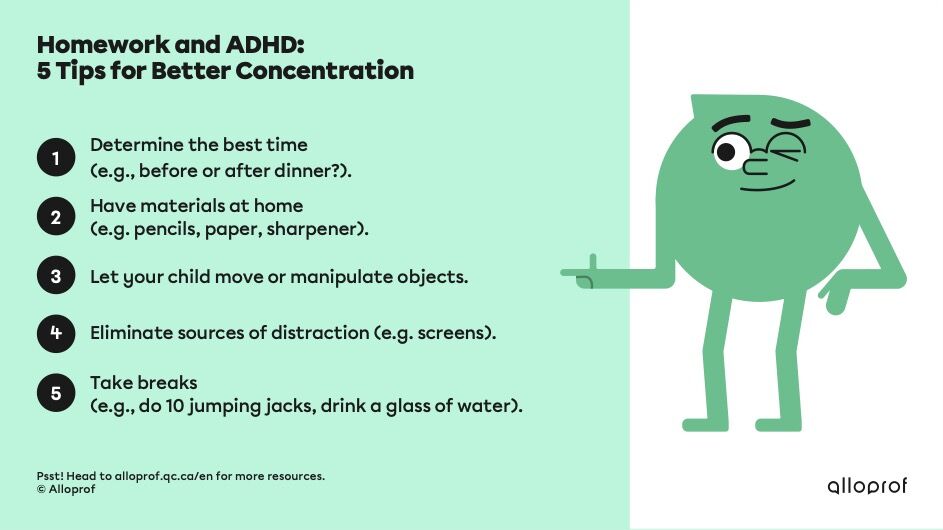
Different study strategies will work better for different children. Here are a few other tips to help your child concentrate:

Tips and tools

Although ADHD is not a learning disorder per se, it can affect learning processes. Thus, it is important to distinguish learning difficulties associated with ADHD from those associated with a true learning disorder, since the adaptation measures, although sometimes similar, are specific to each difficulty.

Alloprof Parents has compiled its best articles and resources related to learning disorders in the Learning Disorders collection. You can also ask a specialist on our team for advice, and they will point you in the right direction.

Homework and ADHD: 5 Tips for Better Concentration.

Trouble Staying Organized

Young people with ADHD can struggle with time management when it comes to getting homework done. Hélène explains how empowerment and structure help her child: “Letting him decide what he does on what day and in what order improves his motivation, and so does letting him work standing up. Kids need to have a sense of control and not feel overwhelmed by their assignments. We also break down the work into smaller steps, with frequent breaks to avoid cognitive overload.”

Marie-Isabelle says that making daily and weekly lists was a strategy that worked well for her (homework to finish, homework to hand in, topics to study for the test in X days, etc.). “Also, I had a system with different symbols and colours, so that the next day I knew what questions I had to ask my teacher.”

Gabriel also shared some tips that worked for him:

  • Set specific goals: “I have to do _______ because _______. I should be finished in about ______ (minutes/hours/days).”

  • Try to understand the purpose of an assignment or a lesson, because we tend to be more focused when we feel motivated. Knowing how a concept can be applied in real life can be very motivating!

  • Read sections of the textbook before class. This can help students be more attentive in general, both during class and while doing homework. “For me, it was useful to go over a concept in my textbook before going to class, in case I spaced out while the teacher was talking.” According to Université Laval (link in French), reading up on a topic before class helps students with ADHD keep up during lessons, since listening in class can be a real challenge for young people with the disorder.

Laura, on the other hand, has her own organizational routine:

  • Create a preparation routine and post it near your child’s study space (e.g., 1. Get out my agenda. 2. Make a list of my homework assignments in order of priority. 3. Keep the list where I can see it.

  • Make sure your child has all the materials they need for their assignment (so they don’t have to get up halfway through and find an eraser or their calculator).

  • Ask your child what they already know about the subject and have them explain it in their own words. It helps them ease into homework mode and reactivate their knowledge.

  • While your child is reading their assignment instructions, ask them to rephrase the instructions to make sure they understand what to do and are on the right track.

  • Use a draft notebook so your child can scratch out their work without stressing about it. This allows them to focus solely on the task at hand and only worry about copying their work out neatly and legibly later on.

  • When an assignment is finished, put away anything your child no longer needs. The only things they should have in front of them are the materials they need for their current task.

  • Check off homework assignments that have already been finished. It will give your child a sense of pride in the work they’ve done and help them take stock of their progress.

Opposition to Homework and Self-esteem Issues

Some children may resist doing homework. Often, this behaviour is related to a lack of confidence or low self-esteem. Children with ADHD often have a poor self-image, as they sometimes have trouble finishing tasks that other people find “easy.” This may be because of their attention wandering, a tendency to rush through things, or simply not hearing the instructions. Children with ADHD are also more likely to be scolded for their behaviour (“they fidget too much,” “they talk too much,” “they’re disruptive”), which can lead to a negative inner monologue. “Since children with ADHD are more likely to suffer from low self-esteem, it's important to do everything in our power to protect and strengthen their self-esteem.” (Élisabeth Boily, resource teacher at Aider son enfant)

Marie-Isabelle shares: “My dad used to cut out a cardboard smiley face for me to put on my desk during exams. It reminded me that he believed in me, which helped me tell myself it was going to be okay.”

Lisa shares her advice with us: “As a parent, you have to be patient and avoid being hard on your child and yourself. Take a break after school, have a snack, and set a timer so that your child can do their homework in small chunks. Keep in touch with the school and ask if it’s possible to cut back on homework assignments when your child feels overwhelmed.”

Tips for Staying Positive

Living with ADHD can make homework and studying more difficult on a daily basis. Remember to acknowledge your child’s efforts and celebrate their wins. Here are some other thoughts shared by survey respondents to help you stay positive.

  • “Recognizing and accepting that your child has ADHD is tough, but try to see the glass as half full. Kids with ADHD can have a lot of energy, which can be an asset if that energy is properly channelled.” (Lisa)

  • “Children with ADHD are often very creative, which can be a strength during homework time.” (Marie-Isabelle)

Conclusion

It is extremely important to help your child discover their value beyond academic performance, whether via sports, crafts, art, or social interactions. You play a crucial role by frequently giving your child with ADHD the opportunity to excel and truly enjoy themselves. Highlight their strengths (e.g., creativity, originality, intuition, sensitivity, drive) and positive character traits (e.g., courage, sensitivity). By identifying and valuing their interests and skills, while remaining attentive to their needs, you will be able to guide them toward success.

References