Subjects
Grades
 100%
100%
 100%
100%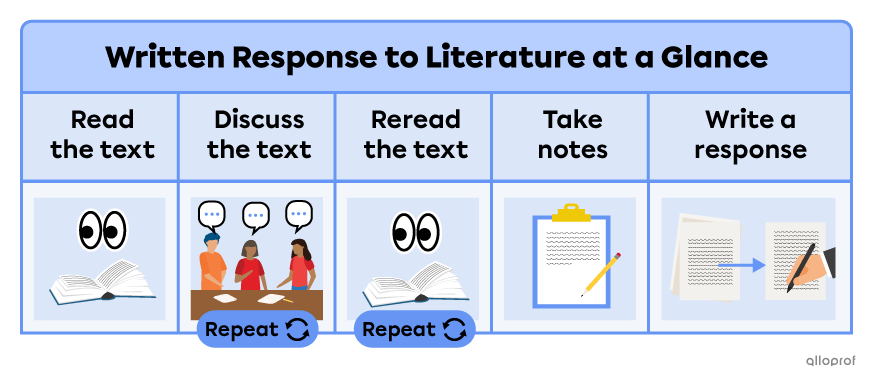 100%
100%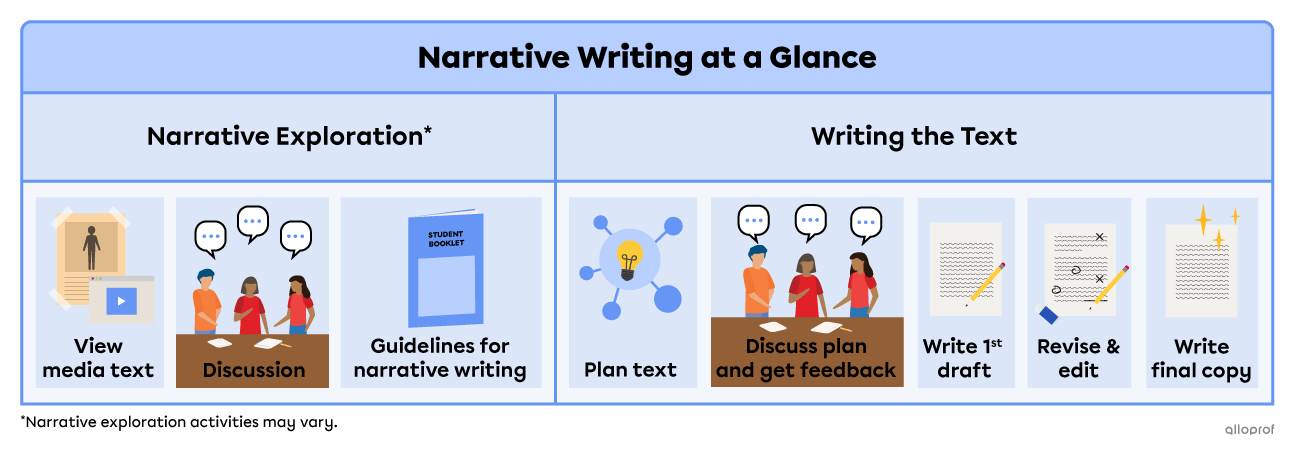 100%
100%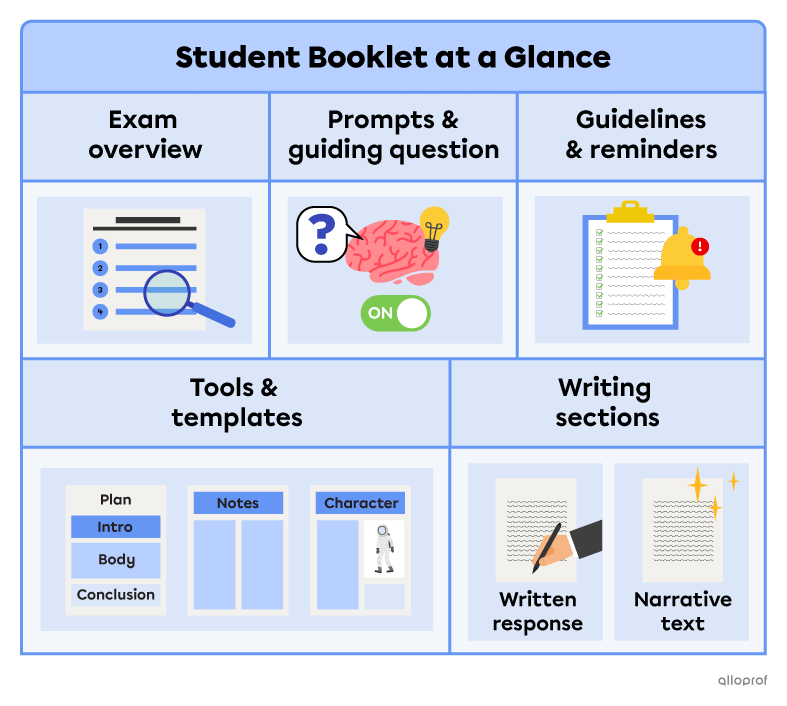
|
Material |
Authorized |
Unauthorized |
|
Standard English dictionary |
✔ |
|
|
Bilingual dictionary (English and 1 other language) |
✔ |
|
|
Thesaurus |
✔ |
|
|
Electronic devices |
|
X |
|
Smart devices |
|
X |
|
Digital tools |
|
X |
|
Homemade documents & notes |
|
X |
Students with adaptive measures for their academic progress will be allowed to use their prescribed tools.
Make sure to check with your English teacher if you have any doubts.
The ELA grade 6 ministry exam is a reading and writing skills evaluation.
|
Tasks |
What is evaluated |
|
Competency 1 |
|
|
Competency 2 |
Note that competency 2 (To write self-expressive, narrative and information-based texts) is only evaluated in the narrative writing task.
It is not evaluated in the written response task.
Competency 4, To use language to communicate and learn, is used throughout the exam, but is not evaluated as part of the exam.
Teachers can choose to evaluate it as part of their ongoing student assessment. It does not affect the exam result.
The exam takes place over a period of a few days, starting in May.
A total of about 7 hours is necessary to complete all the tasks.
|
Material |
Authorized |
Unauthorized |
|
Standard English dictionary |
✔ |
|
|
Bilingual dictionary (English and 1 other language) |
✔ |
|
|
Thesaurus |
✔ |
|
|
Electronic devices |
|
X |
|
Smart devices |
|
X |
|
Digital tools |
|
X |
|
Homemade documents & notes |
|
X |

Students with adaptive measures for their academic progress will be allowed to use their prescribed tools.
Make sure to check with your English teacher if you have any doubts.
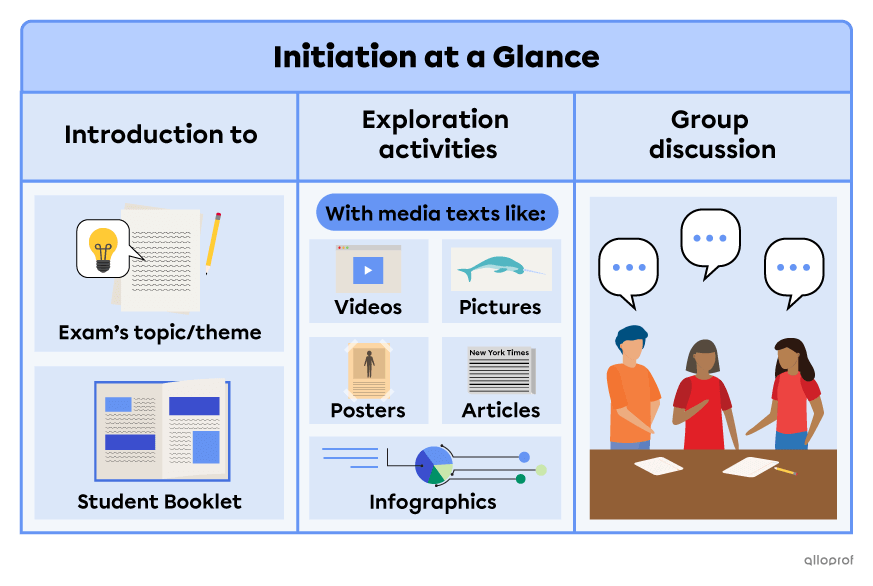
There are 3 main parts to the exam.
The initiation is the first step where the theme or topic of the exam is introduced.
It helps you get ready for the coming evaluation, by activating your prior knowledge.
|
What happens during the initiation |
Good to know |
|
Introduction to exam’s topic or theme |
• Topics/themes vary from year to year |
|
Introduction to the Student Booklet |
• Used throughout the exam |
|
Exploration activities with media texts (infographic, video, poster, article, picture…) |
• Media text types vary from year to year |
|
Group discussion(s) |
• May be done as a whole class or in small groups |
The initiation portion of the exam lasts about 1 hour.
Keep in mind that the order in which activities are done and the specific media texts used vary from year to year.
The written response task evaluates the student’s reading skills.
→ Competency 1:To read and listen to literary, popular and information-based texts.
|
Written response task steps |
Good to know |
|
Read a text |
• Topic/theme related to the initiation’s introduction activities |
|
Discuss the text Reread the text Take notes |
• Steps may occur in a different order |
|
Write a response |
• Only Competency 1: To read and listen to literary, popular and information-based texts is evaluated |
This task can be performed over a few days and takes a total of 2 to 3 hours to complete.
The narrative writing task evaluates the student’s writing skills.
→ Competency 2:To write self-expressive, narrative and information-based texts.
|
Narrative writing task steps |
Good to know |
|
|
Narrative exploration |
View media texts |
• Media text types vary from year to year |
|
Discussion |
• May happen at different times |
|
|
Review guidelines for |
• Found in the Student Booklet |
|
|
Writing the text |
• Templates available in the Student Booklet |
|
|
Discuss plan |
• May be be done at different times |
|
|
• Rough copy |
||
|
• Can be written in pencil or pen |
||
This task can be performed over a few days and takes a total of 2 to 3 hours to complete.
The student booklet is used in every step of the evaluation.
|
Elements found in the Student Booklet |
|
|
Exam overview |
• A short description of each of the exam steps |
|
Initiation prompt or guiding questions |
• Helps to activate your prior knowledge |
|
Guidelines |
• Elements to include |
|
Tools & templates |
• Note-taking templates |
|
Writing sections |
• 1 written response |
The tools, templates and guidelines vary from year to year to match the topic or themes of the exam.
In the written response, you must show your understanding of the text.
The following criteria can help guide you with what to include.
Keep in mind!
Focus on 1 or 2 of these criteria in your response, there is no need (or room!) for all of them.
Refer to, quote or point out any specific part of the text that you are able to analyze, interpret or draw conclusions from.
Always explain the reasoning behind your interpretations, opinions and connections.
Review your work to make sure you completed Step 2!
Identify and interpret the text’s ideas, themes or messages.
Read between the lines!
This is where you:
• Look for clues in the text
• Use your personal knowledge
• Draw conclusions
• Justify your conclusions
Ask yourself questions like:
• What is the text really about?
• What meaning can you infer beyond what was explicitly stated in the text?
• What is the overall idea or theme?
• What is implied?
• What message is the author trying to get across?
• What is the author’s intention?
• How do these ideas/messages help you understand the text?
Identify the elements that carry meaning and explain how they help you better understand the text.
Examine elements like:
• Text genre & type
• Narrative text structure (beginning, middle and ending)
• Character type (main character, supporting character, villain…)
• Character actions & dialogues
• Visuals (pictures and illustrations)
• Story setting (time, place, social context)
• Patterns and repetitions in the plot
Ask yourself questions like:
• Why did the author use this genre to tell the story?
• How does it affect the meaning of the text?
• How is the text structured?
• Why did the author choose to structure it this way?
• How do character actions or dialogues reflect the text’s ideas or theme?
• How are the visuals used?
• Why did the author choose this setting to tell the story?
• How did the author’s writing style choices help or hinder your understanding of the text and, if so, how?
Make connections to the text and explain how and why they help you draw meaning from the text.
Make connections between the text and:
• Personal experiences
• Personal knowledge
• Other texts you’ve read
• Movies, videos, shows you’ve seen
• Current events
• Social issues
• Real-life situations
Evaluate the quality and effectiveness of the text.
Look for:
• What makes the text work well
• How the message or theme is expressed
• How the author grabs the reader’s attention and interest
• The author’s intention or purpose
Ask yourself questions like:
• How well does the text work?
• What specific elements make it work?
• How effective is the text at expressing a message or a theme?
• How well does the author keep the reader’s attention?
• How effective is the text in conveying the author’s intention?
In the writing task, you must show how well you understand narrative writing.
Concepts to pay attention to:
Remember to have:
• A clear focus on one idea, theme or topic
• An engaging beginning and a strong ending
• A story that develops in a logical sequence of events
• A story that unfolds smoothly, with clear transitions
• Details to enrich your story and support its development
Speak to the audience with:
• A consistent point of view—third person or first person narrator
• A consistent and captivating tone (humourous, sad, formal, friendly…)
• A perspective that supports the story’s idea, theme or topic
• A deliberate intention to engage the reader
Remember to:
• Follow the narrative structure (beginning, middle & end)
• Have events support the story’s idea, theme or topic
• Make the best word choices to enrich the story
• Use character actions and dialogues to assist the plot
• Choose a setting that supports the story’s idea, theme or topic
• Follow the conventions of the narrative genre
Double-check
• Spelling
• Punctuation
• Capitalization
• Simple sentence structure
• Compound & complex sentence structure
Refresh your reading skills by visiting the Reading Strategies concept sheets.
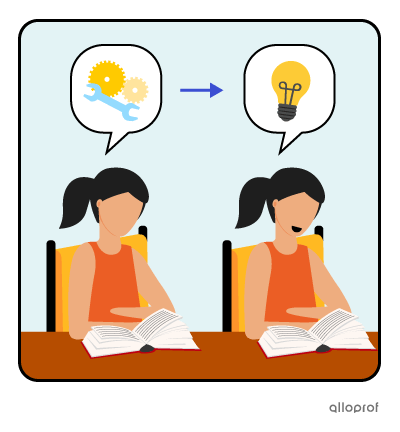
Visit the Response Process concept sheet to remember what the different steps are.
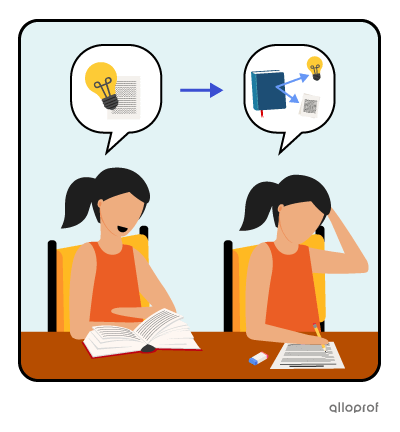
Visit the Writing Process concept sheet to go over the writing steps.