Subjects
Grades
 100%
100%
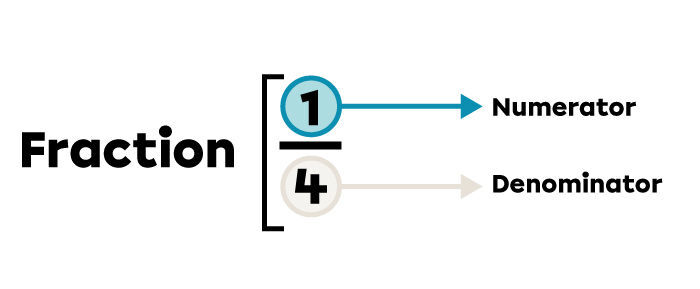
A fraction often represents a part of a whole or a part of a set.
The fraction is always made up of a numerator and a denominator.

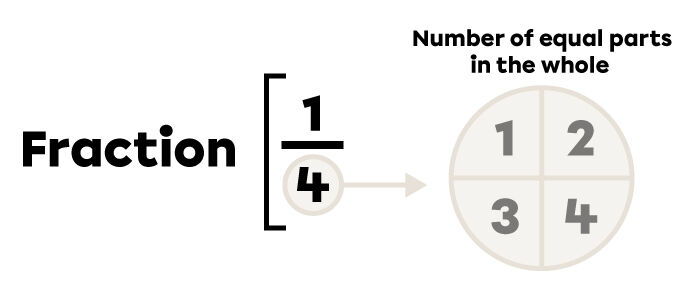
The denominator is the number below the fraction bar (line). It represents the number of equal parts into which the whole has been divided.
The denominator of the fraction |\dfrac{1}{4}| means that the whole is divided into |4| equal parts.
The numerator is the number above the fraction bar. It represents the number of equal parts being used.
The numerator of the fraction |\dfrac{1}{4}| means that 1 part is used.
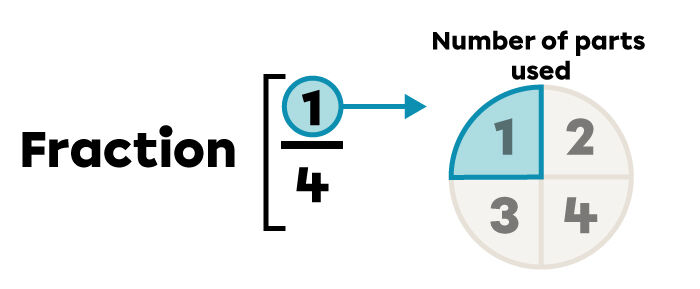
A fraction can be represented in different ways: using circles, rectangles, or a set of objects.
Read the following concept sheet to learn more.
Ordering fractions means comparing them so they can be placed in ascending or descending order.
Read the following sheet to learn more.
A fraction is equivalent to another when it represents the same part of a whole or set.
Read the following concept sheet to learn more.
A fraction is in lowest terms when the numerator and the denominator have only 1 as a common divisor. The fraction is then in its simplest or irreducible form.
Read the following concept sheet to learn more.
A mixed number is made up of an integer part (a whole number) and a fractional part (a fraction).
Read the following sheet to learn more.
Fractions can be added once they have the same denominator.
Read the following concept sheet to learn more.
Fractions can be subtracted once they have the same denominator.
Read the following concept sheet to learn more.
To multiply a fraction by a whole number, use repeated addition or place the whole number over |1| |(\dfrac{?}{1})|.
Read the following concept sheet to learn more.