Subjects
Grades
 100%
100%
 100%
100%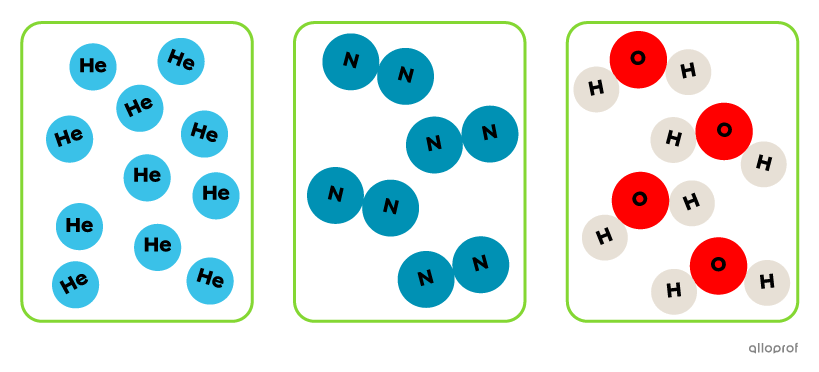 100%
100%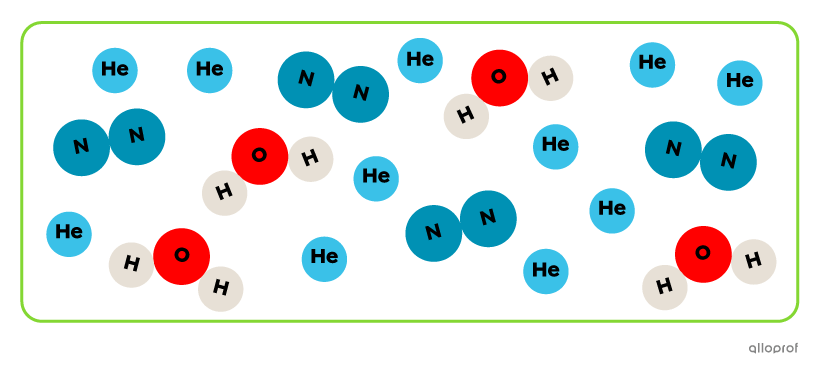 100%
100%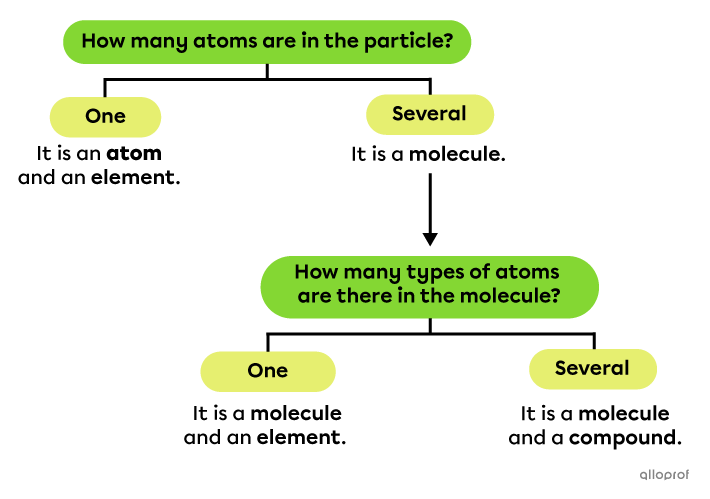
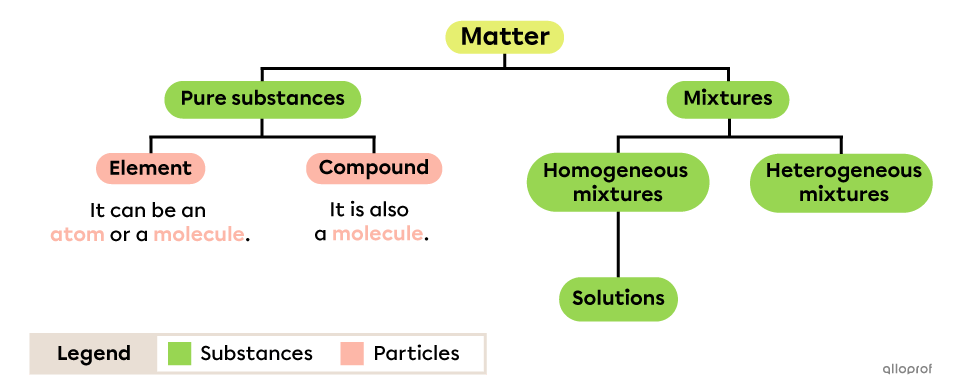
Matter makes up all substances that have a mass and occupy space.
All substances are made up of matter, whether they are pure substances, homogeneous mixtures (solutions) or heterogeneous mixtures.
A pure substance can be made up of different types of particles, either elements or compounds, which are also atoms or molecules. A mixture is made up of different pure substances mixed together.
The organization, properties and behaviour of these particles of matter can be represented and explained using the particle model.

A pure substance is made up of a single type of particle.
A heterogeneous mixture is made up of several pure substances and it is possible to distinguish several components.
A homogeneous mixture is made up of several pure substances and it is impossible to distinguish the components.
A solution is a homogeneous mixture in which one substance, called the solute, is dissolved in another, called the solvent.
To find out more about pure substances, mixtures and solutions, check out these concept sheets:
Three pure substances
All three substances contain a single type of particle. The substance on the left contains only helium atoms (He), the substance in the centre contains only nitrogen molecules (N2) and the substance on the right contains only water molecules (H2O).
A mixture
The substance contains different types of particles. It is a mixture of helium (He), nitrogen (N2) and water (H2O).
Whether it's a pure substance or a mixture, a substance is made up of particles. Here are four ways of describing them, depending on their structure.
An atom is a particle of matter invisible to the naked eye. It is the building unit of a molecule.
A molecule is a particle made up of at least two atoms chemically bonded together.
An element is a particle made up of only one type of atom.
A compound is a particle made up of several types of atoms.
Moments in the video :
Moments in the video :
To identify whether a particle is an atom, an element, a molecule and/or a compound, it is helpful to ask the following questions:
The classification of particles.