Adjectives

Fiche | Anglais
Definition

What Are Adjectives?

Adjectives are words used to describe or modify a noun or a pronoun. They give extra information to make sentences more precise and interesting.

Be careful!

Adjectives do not have a plural or singular form: they always stay the same.

Only adjectives used as determiners have plural forms. They are the:
Adjective Placement

Rules

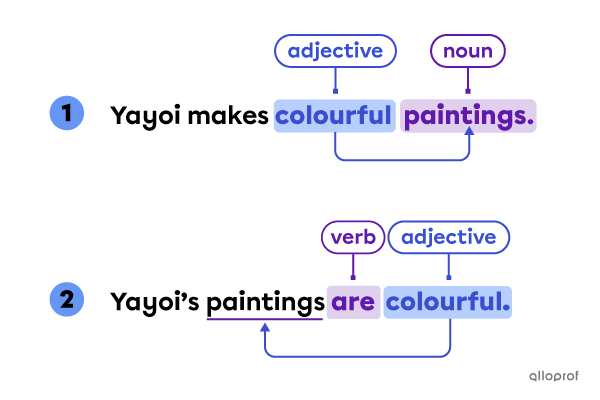
Adjectives can be placed:

  1. Before a noun

  2. After a verb

Adjective placed before the noun and adjective placed after the verb.

Advanced Users: Adjectives after a Noun or a Pronoun

Adjective Placement—Exercise

'

Order of Adjectives

Rules

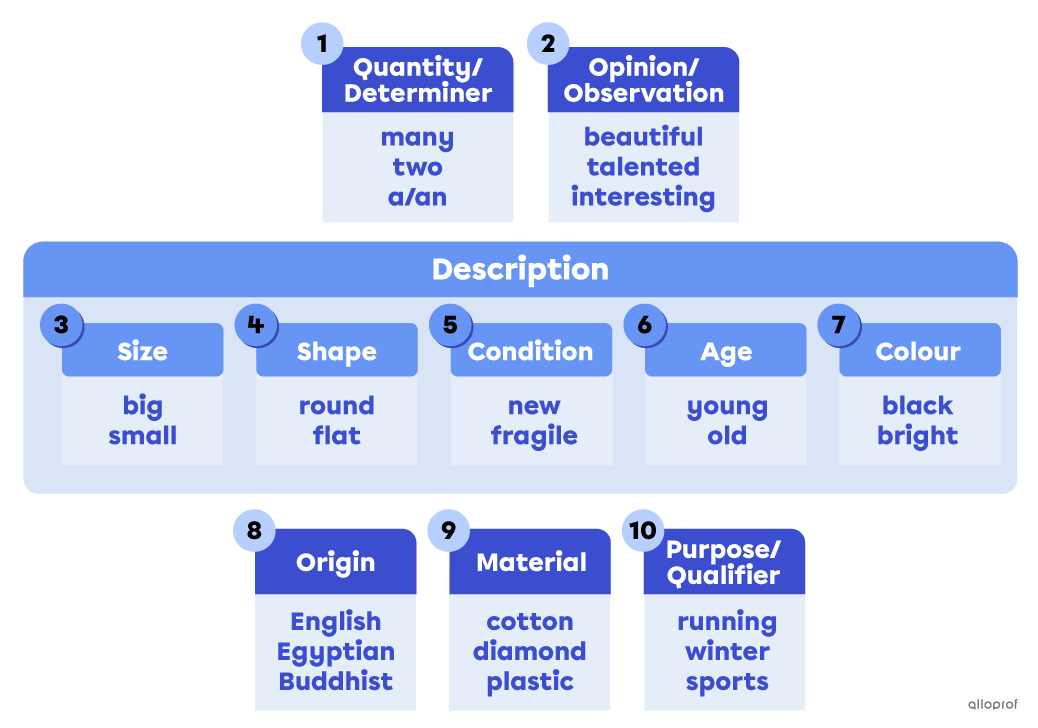
When using more than one adjective to describe a noun or a pronoun, use the following order:

Order of adjectives table.
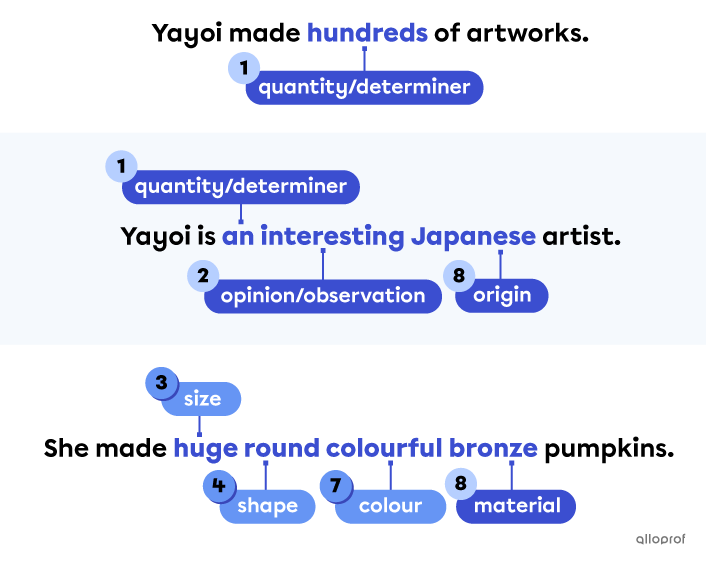
Examples
Order of adjectives examples.

Order of Adjectives—Exercise

'

Overused Adjectives—Using Richer Adjectives

Tips

Some adjectives get overused. 
Here are some alternatives:

Another way to say…

nice

good

bad

great

best

more

kind
friendly
sweet
lovely
pleasant
likeable

excellent
terrific
amazing
marvellous
sensational 
fantastic

awful
unpleasant
dreadful
nasty
wicked
poor

exceptional
wonderful
tremendous
first-class
first-rate
absolute
surpassing

first
finest
leading
highest
principal
foremost
prime

additional
extra
new
other
added
increased
beyond

small

big

easy

difficult

cool

funny

little
tiny
miniature
puny
microscopic
meagre

huge
massive
enormous
colossal
gigantic
substantial

simple
effortless
smooth
straightforward
painless
basic
accessible
obvious
uncomplicated

tough
hard
complex
complicated
troublesome
arduous
challenging
demanding
strenuous

relaxed
quiet
assured
composed
self-controlled
collected
calm

amusing
entertaining
hilarious
playful
silly
whimsical
humourous

happy

sad

angry

new

young

old

glad
joyful
cheerful
delighted
thrilled
ecstatic
lively
merry
upbeat

unhappy
depressed
gloomy
miserable
grieved
regrettable
tragic
grieved
sorrowful

mad
furious
outraged
displeased
annoyed
touchy
infuriated
heated
exasperated

recent
current
late
modern
advanced
fresh
original

blooming
blossoming
youthful
green
juvenile
childish
childlike

aged
ancient
decrepit
elderly
mature
venerable
senior

Comparative & Superlative Adjectives

Rules

Comparative and superlative adjectives are used to compare things or people.

Comparative adjectives compare two things or people.

For example comparing two people’s age:

Person 1

Age comparison

Person 2

Yayoi is

older than

Ushio.

Superlative adjectives compare more than two things or people.

For example comparing one person’s age to several other people’s ages:

Person 1

Age comparison

All other people

Yayoi is

the oldest

artist in the group.

Visit the Comparative & Superlative Adjectives concept sheet to learn more about them.

Possessive Adjectives

Rules

Possessive adjectives are used to indicate ownership of a noun, who it belongs to.

The possessive adjectives are:

my

your

his
her
its

our

your

their

Visit the Possessive Adjectives concept sheet to learn more about them.

Demonstrative Adjectives

Rules

Demonstrative adjectives are used to:

  • point something out

  • indicate the position of an object

  • indicate singular and plural

The demonstrative adjectives are:

this

that

these

those

Visit the Demonstrative Adjectives concept sheet to learn more about them.

Adjectives for Advanced Users

For Advanced Users: Interrogative Adjectives

For Advanced Users: Interrogative Adjectives

For Advanced Users: Nouns & Verbs as Adjectives

For Advanced Users: Nouns & Verbs as Adjectives

For Advanced Users: Proper Adjectives

For Advanced Users: Proper Adjectives

For Advanced Users: Compound Adjectives

For Advanced Users: Compound Adjectives

The Real-Life Yayoi